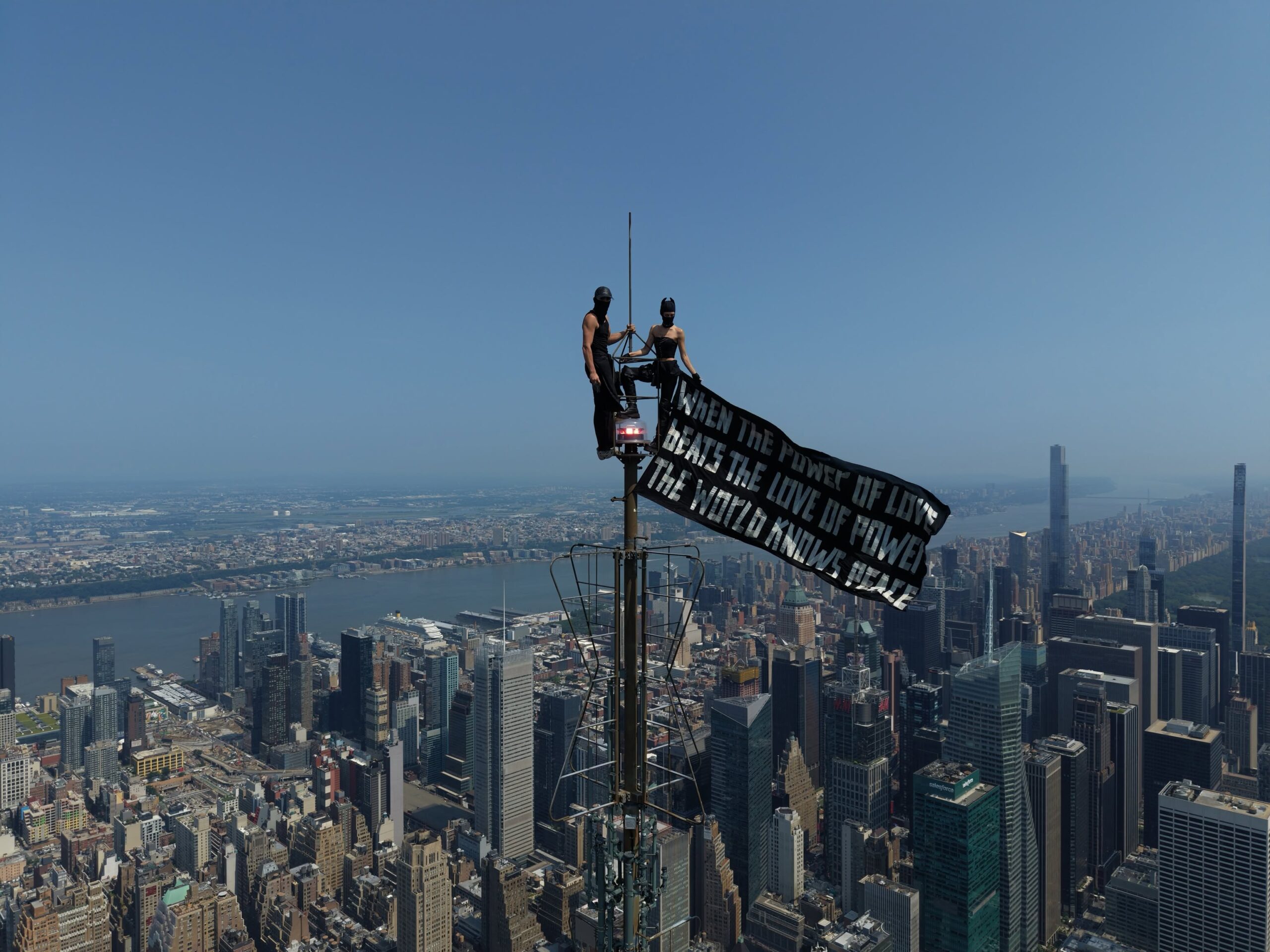
A Proposal on top of the Empire State Building
On July 1, 2026, two Russian rooftoppers climbed the antenna of New York's iconic skyscraper and got engaged up there. They were arrested. But the internet couldn't be stopped. The best marketing teams jumped on it within minutes.
Source: Facebook - Angela Nikolau
Canva, Duolingo, Cisco and others responded to an illegal rooftop climb with a single designer in a matter of minutes - and earned millions of organic impressions. That wasn't luck. It was the fastest, cheapest, and most effective form of moment marketing.
On July 1, 2026, Angela Nikolau and Ivan Kuznetsov illegally climbed the antenna of the Empire State Building, where a marriage proposal took place. The images they uploaded went viral within hours, and several global brands (Canva, Duolingo, Cisco, Tarte Cosmetics) immediately integrated the event's visuals into their own communication. This strategy is called trendjacking.
What exactly happened on July 1, 2026?
Angela Nikolau and Ivan Kuznetsov (alias Ivan Beerkus) - the stars of the Netflix documentary Skywalkers: A Love Story - illegally climbed the 1,454-foot (approx. 443-meter) antenna of the Empire State Building. Kuznetsov proposed to Nikolau up there, while they unfurled a large black banner reading: "When the power of love beats the love of power the world knows peace."
The act was illegal: unauthorized entry into the building and dangerous high-altitude activity. The couple was taken into custody immediately upon descent. With that, the stunt was over - but the internet had just gotten started.
The couple uploaded their footage, which first spread through their personal channels.
Social media teams at global and local brands reacted immediately. Their designers modified the image, placed their own messages on the banner, and the organic reach rolled over them too.
What is trendjacking, and why is it the best form of moment marketing?
Trendjacking is the marketing strategy in which a brand consciously and quickly responds to a currently viral event or trend and integrates it into its own communication narrative. The goal: to share in the existing attention and emotional charge without having to plan an expensive campaign. Related concepts of trendjacking are newsjacking (reacting to news) and moment marketing. All three follow the same principle: the user is already paying attention, the brand just needs to join in.
Trendjacking is nothing new. Marketing expert David Meerman Scott described the concept of newsjacking as far back as 2011. What has changed is the speed and the visual toolkit. In 2026, a smart social media team can Photoshop, write copy, and publish a reactive post within minutes. The Empire State Building stunt was the ideal trendjacking material precisely because the empty surface of the banner functioned as a ready-made digital billboard.
Why was this stunt perfect for trendjacking? The anatomy of a viral storm
Not every event lends itself to trendjacking. The Empire State Building stunt was ideal raw material from almost every angle. Let's look at why:
A proposal. Heights. Daring. Love. There is no culture in which these concepts don't trigger an immediate emotional response. Trendjacking works best when the core event needs no explanation - the emotions do the work instead.
The Empire State Building isn't simply a tall building: it's a cultural symbol. Everyone in the world knows what it is. That means a reactive post needs no contextual explanation - the location communicates on its own.
This was the real golden ingredient of the trendjacking. The large, empty surface of the black banner functioned as a ready-made blank billboard. Brands only needed one designer to swap out the original text for their own message in Photoshop - and a relevant, contextualized post was ready.
Angela Nikolau and Ivan Kuznetsov are not unknown people. The Skywalkers: A Love Story documentary was released on Netflix in 2024, meaning they already had a global fan base. That means the event didn't have to start from zero in the competition for attention.
An event makes good trendjacking material if it's quickly understandable, emotionally charged, visually customizable, and its values don't conflict with the brand's values. The Empire State Building stunt fulfilled all four. The illegal nature does carry risk for brands - but as you can see, most reactive posts handled this with humor rather than glorifying the law-breaking.
Brands that jumped in: real examples of trendjacking
Let's look at which global brands reacted, how they did it, and what the logic was behind their messaging. Every single post is a marketing decision - and there's something to learn from each one.
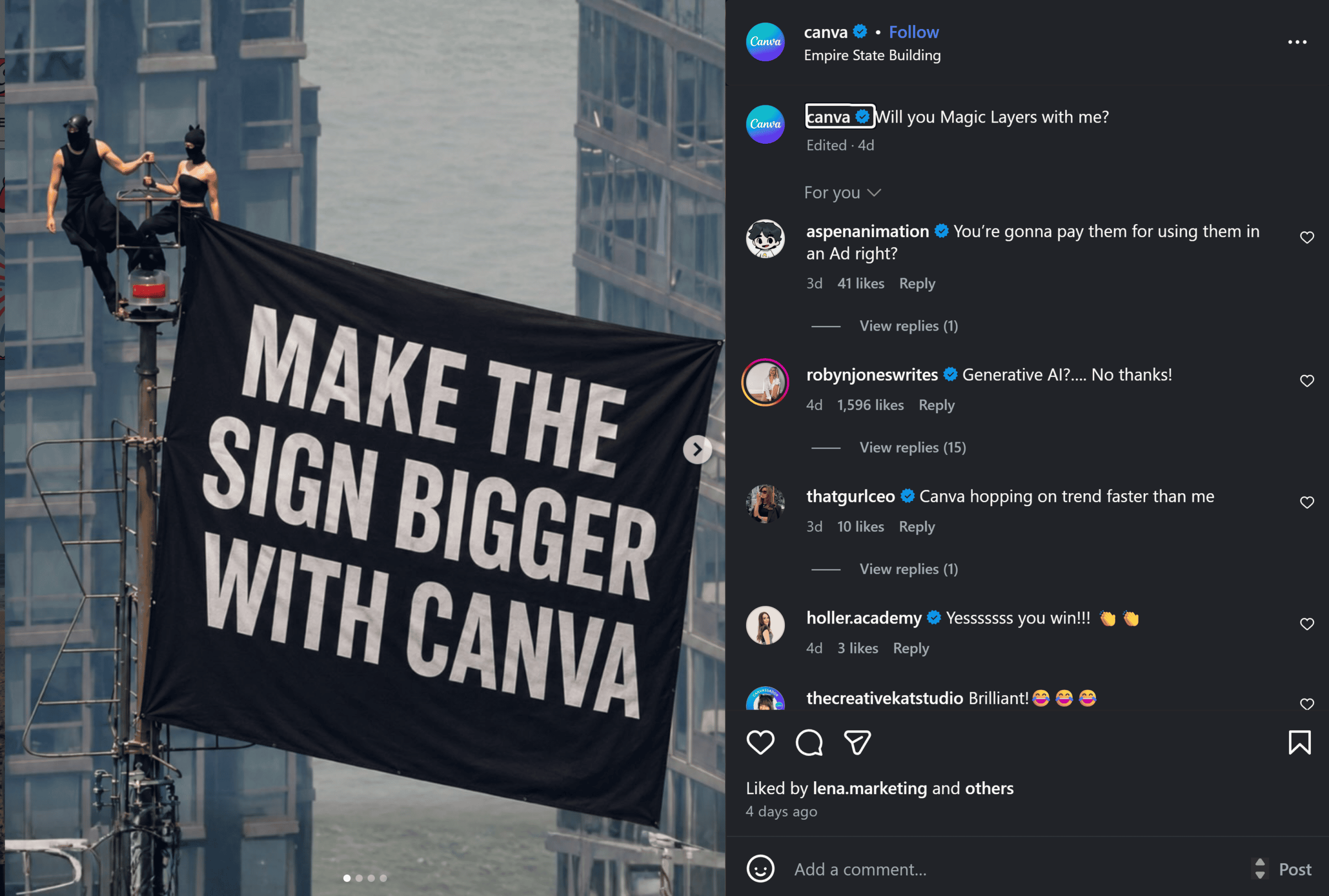
Source: Instagram - Canva
Canva put their own product at the center of the joke: they digitally enlarged the banner and added their own tagline. This is trendjacking at its finest: it's not just reactive, it also works as a product demonstration. A globally viral event + one sentence + their own tool = a free, organic, global campaign.
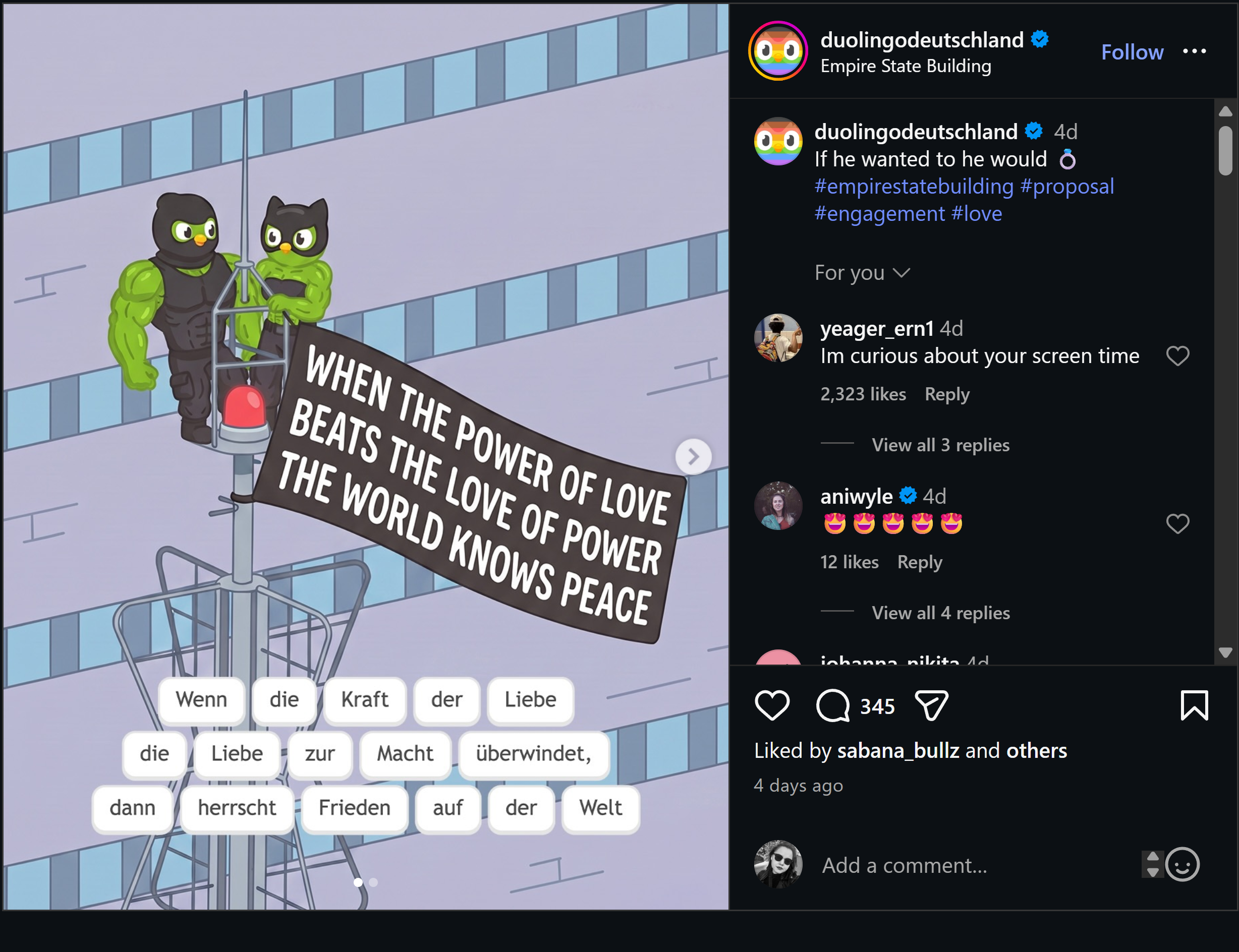
Source: Instagram - duolingodeutschland
Duolingo simply placed a universal relationship meme caption under the image. It's brilliant because it perfectly fits the brand's tone: the app regularly uses relationship humor in its push notifications.
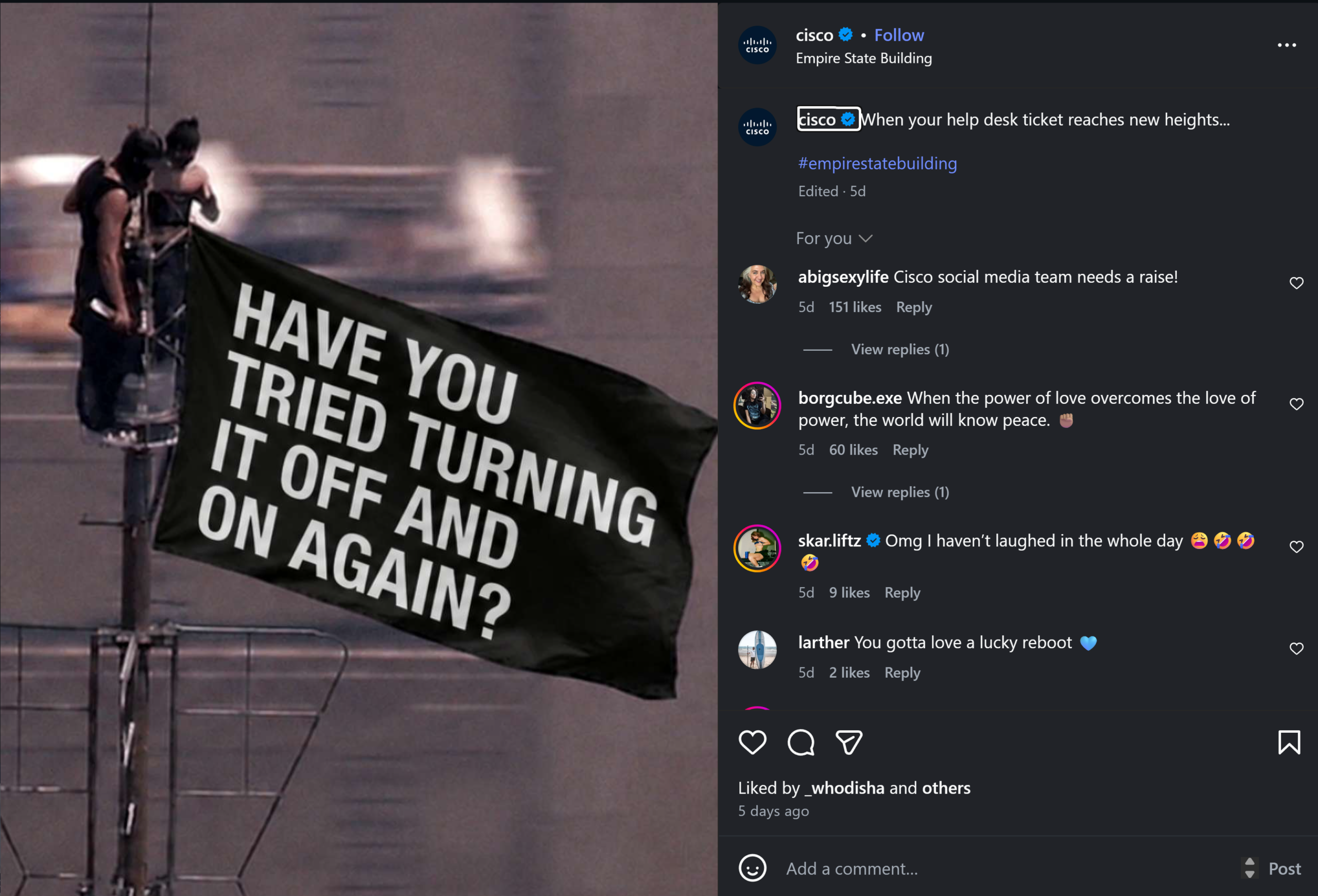
Source: Instagram - Cisco
Cisco brought IT humor to the dizzying heights photo. For anyone in the IT sector, "help desk ticket" is a perfectly familiar concept, and the "reaches new heights" metaphor is obvious. Strong for a niche audience, at least smile-worthy for the broader public. Cisco proved that B2B brands can produce viral, entertaining content too.
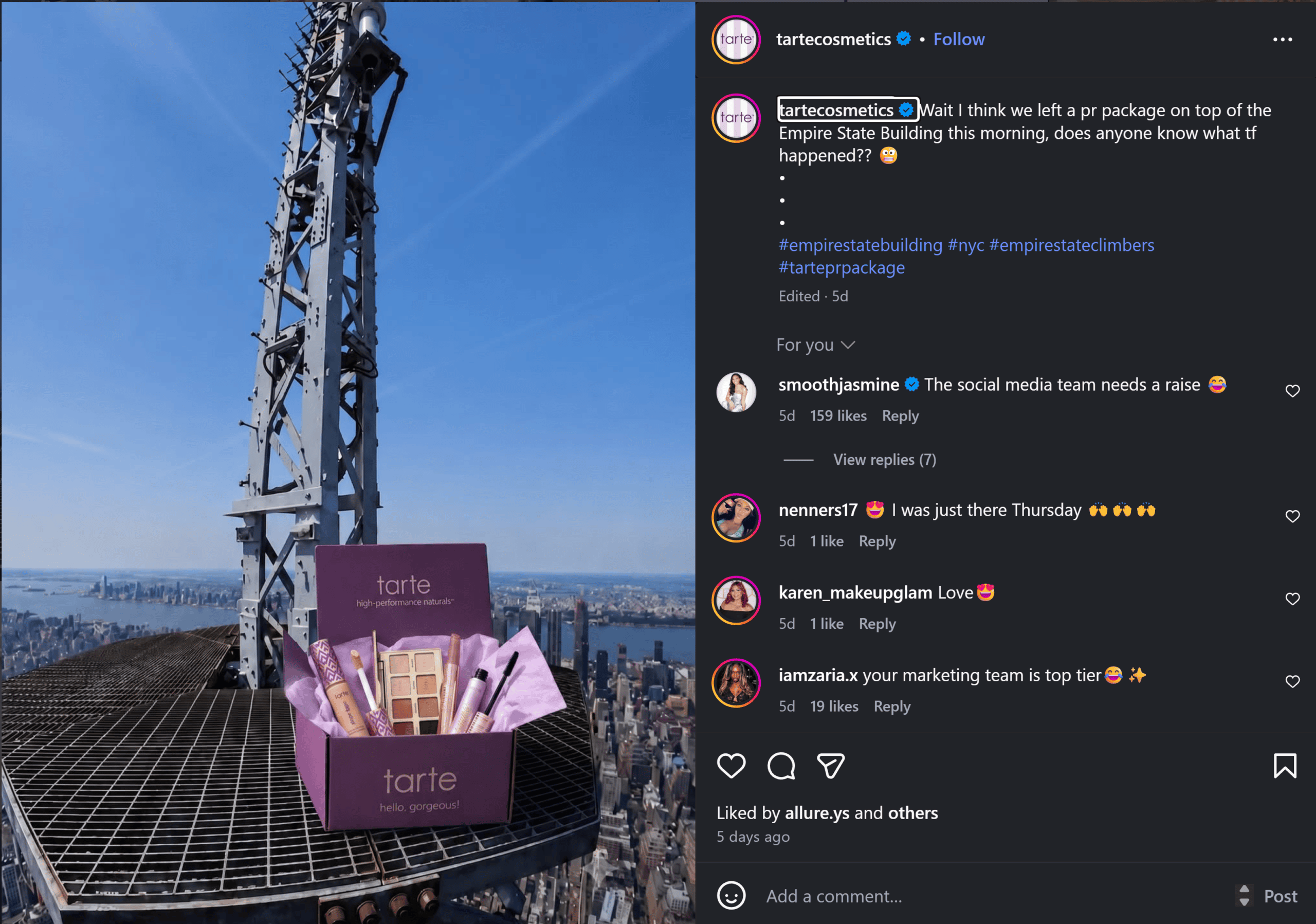
Source: Instagram - Tarte Cosmetics
Tarte didn't hack the banner - they brought personality to the trend. The narrative of the PR package "accidentally left behind" fits perfectly with the brand's tone and the beauty influencer culture.
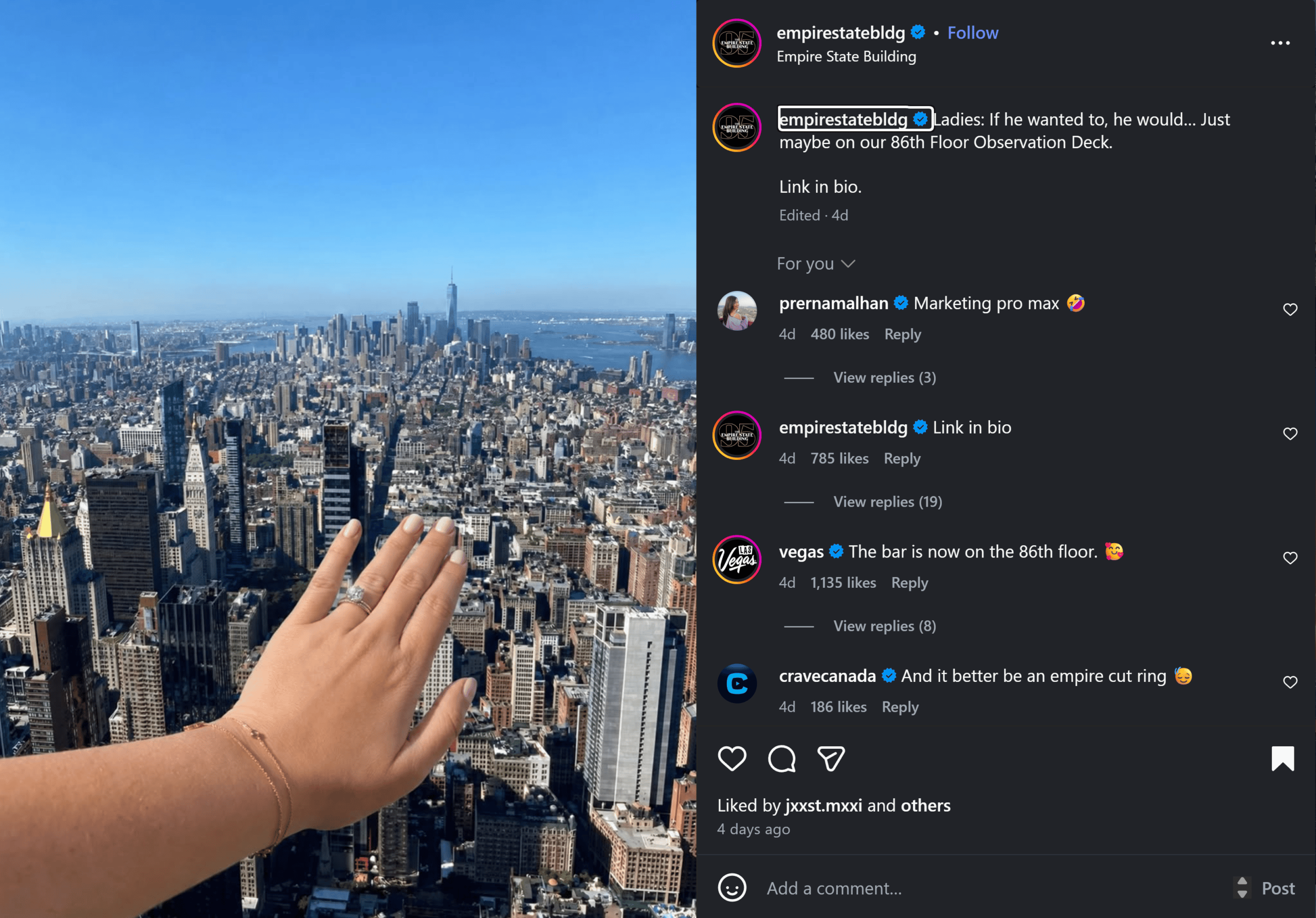
Source: Instagram - Empire State Building
The most brilliant reactive post came from the building itself. The ESB team legally recreated the viral ring photo from the public 86th floor observation deck, then promoted their $1,000 "Happily Ever Empire" proposal package. A PR crisis became a revenue opportunity. This is a textbook case of a pivot.
The Empire State Building's brilliant pivot: turning a PR crisis into revenue
The Empire State Building team faced a difficult decision: legally and from a security standpoint, this was a serious unauthorized entry. The first instinct in such cases is damage control: a statement, tighter security, distancing. Instead, they did something entirely different.
The best defense against a PR crisis isn't retreat - it's a smart offense. The Empire State Building team didn't deny the event; they turned it to their own advantage.
The ESB social media team legally recreated Nikolau's viral ring POV photo from the public 86th floor observation deck. They added the meme caption ("Ladies: If he wanted to, he would…"), then directed users to a real service: the booking link for the $1,000 "Happily Ever Empire" proposal package.
That single reactive post was simultaneously:
1. Humorous: it matched the tone of the internet. 2. Relevant: it directly connected to the trending event. 3. It sent a safety message: "you can do this too - legally and safely." 4. It generated revenue: it directly linked to a purchasable service. 5. It strengthened the brand: the ESB positioned itself as a romantic, iconic venue - not as an incident.
Moment marketing in 2026: what can we learn from the Empire State Building proposal?
The Empire State Building stunt and the brand reactions that followed give a precise picture of what moment marketing looks like today. Here are the most important takeaways.
The trendjacking window is narrow. What's viral today is stale tomorrow. Canva and Duolingo didn't wait weeks for approval chains from marketing directors - they acted. In reactive marketing, acceptable quality published on time is worth more than perfect quality published late.
Cisco jumped in with IT humor. Duolingo with a relationship meme. Tarte joked about a PR package. Everyone spoke in their own voice. Trendjacking only works if the reactive post fits the brand's existing character - otherwise it comes across as exhaustingly forced.
The stunt was illegal. None of the reacting brands glorified the law-breaking - they handled it with humor but didn't promote it. That's an important distinction. Trendjacking becomes dangerous when a brand visibly aligns itself with a legal violation or a tragedy. The ESB had to be especially careful about this - and they were.
The banner was the trendjacking engine of the whole case. Without that customizable visual element, the brand reactions would have been a fraction of what they were. Marketers should learn to recognize these "blank billboard" moments - when a viral event provides a ready-made visual framework.
The ESB's pivot wasn't just a funny post. It drove traffic to a concrete product (the $1,000 proposal package). The best forms of reactive marketing also serve a real business goal: leads, bookings, downloads, purchases. Humor alone isn't enough if there's no conversion intent behind it.
Frequently asked questions
Which brand's reactive post did you find the most brilliant? Was there one you think got it wrong - or did something right that isn't mentioned here? Leave a comment below, especially if you work in social media marketing yourself, or if you were one of the first to see these posts.
Sources and references
YouTube: Empire State Proposal Goes Viral; Canva, Cisco & Duolingo Join the Trend (news segment) · Netflix: Skywalkers: A Love Story (2024) - Angela Nikolau and Ivan Kuznetsov documentary · Canva - design platform · Empire State Building - official website