Budgeting for singles: 3 proven steps for financial growth
Do you reach the end of every month with more money anxiety than money left in your account? Budgeting for singles is not primarily a math problem. It is a nervous system problem. This article shows you how to reduce financial stress with three concrete tools: a weekly allowance system, a mini emergency fund, and letting go of financial shame.

Have you ever asked yourself how to budget when living alone without feeling completely overwhelmed? The problem is rarely that you cannot do the math. The problem is that you are the only one holding everything together. In 2026, mindful spending has become less of a lifestyle trend and more of a survival skill for solo earners, because the psychological toll of being the only provider is real, and it deserves to be taken seriously.
Why is it harder alone? The anatomy of money anxiety and holding the wall
When you live alone, you are the single line of defence between yourself and everything that could go wrong. Psychologists call this state "holding the wall": a continuous, low-level alertness the brain maintains because there is no one else to share the load or step in when things get difficult.
This is not a character flaw. It is a biological response. According to research by Matone Counseling, the brain processes financial uncertainty the same way it processes physical threat. The prefrontal cortex, responsible for rational planning, gradually exhausts itself under this sustained vigilance. That is why you find yourself avoiding the banking app even when you only intended to take a quick look at your balance.
Money anxiety is not the absence of money. It is the fear of losing control and facing uncertainty, an emotional and cognitive response that triggers avoidance behaviours. It can be reduced in three steps: 1. Introducing a weekly allowance system, 2. Building a mini emergency fund, 3. Rewiring your internal money script. For solo earners, the scarcity stack, the simultaneous shortage of money, time and sleep, intensifies every symptom.
The scarcity stack is the term for this layered pressure: financial scarcity, time scarcity and disrupted sleep all draw from the same cognitive resource. If you often feel like it will never end, that is not pessimism. It is the natural signal of an overloaded nervous system. You can read more about recognising anxiety symptoms and coping strategies if what you are experiencing feels bigger than your budget.
Morgan Housel writes in The Psychology of Money that most financial decisions are driven not by ignorance but by emotional state. When your nervous system perceives danger, rational thinking becomes secondary. Understanding this mechanism is the first genuinely useful step toward breaking the scarcity mindset cycle.
Takeaway: Money anxiety in solo earners is not a personality defect. Holding the wall is a biological phenomenon, and it can be directly eased by a weekly allowance system and a small emergency fund.
Why do I run out of money every month? The micro-decision trap
Most solo earners assume the big expenses are the problem: rent, utilities, loan repayments. These do weigh on the budget, but they are rarely the true cause of end-of-month panic. They are fixed. They are predictable. The brain can plan around them.
The real cause is the accumulation of micro-decisions. Without a clear framework, every small purchase, a coffee, a takeaway lunch, a spontaneous online order, triggers a small stress response. Your brain recalculates each time: "can I actually afford this?" This is decision fatigue, and by the end of the month it has quietly drained your cognitive energy along with your balance.
According to the Intuit 2026 Financial Forecast, consumers are increasingly basing spending decisions on emotional priorities rather than pure calculation. Mindful spending 2026 is not about deprivation. It is about reducing the number of unplanned decisions that quietly drain both your bank account and your mental energy.
The psychological toll of being the only provider is amplified further when children are in the picture. A single parent carries the weight of every financial call alone, with no partner to reality-check a decision or share the guilt when something goes wrong. Everything depends on one internal rulebook, and that rulebook gets exhausted without an external structure to lean on.
| Expense category | Monthly estimate (solo, US average) | Effect on the nervous system |
|---|---|---|
| Rent (1-bedroom, mid-range city) | $1,400-$2,000 | Fixed burden, but predictable |
| Utilities (electricity, gas, internet) | $150-$250 | Partially predictable |
| Groceries (one person) | $300-$450 | Variable, main source of impulse decisions |
| Transport (transit or car) | $100-$200 | Fixed or near-fixed, low stress |
| Dining out or social spending | $150-$300 | Source of guilt without a clear framework |
(Sources: EURES, US Bureau of Labor Statistics, 2025-2026 estimates)
Zero-based budgeting for solo earners runs into the same wall that most frameworks do: they were designed with two incomes in mind. If your fixed costs already consume 60-70% of your take-home pay, no budget formula saves you through willpower alone. That is not a failure of discipline. It is a structural reality of living on a single income, and naming it honestly is more useful than pretending the math should work out differently.
Takeaway: End-of-month panic comes mostly from the absence of a framework, not from the size of individual expenses. A weekly allowance system gives the brain the certainty it needs to stop recalculating every purchase.
The gentle system: how does a weekly allowance system beat money anxiety?
If you want to know how to budget when living alone with less stress, the answer is not a more detailed spreadsheet. It is a system that works with your brain rather than against it. A weekly allowance system is effective precisely because the human brain plans more naturally over a seven-day horizon than a thirty-day one.
At the start of each month, subtract every fixed commitment: rent, utilities, transport, subscriptions and any loan repayments. These are obligations, not part of your budget. Do not negotiate with yourself over them or count them as spending room.
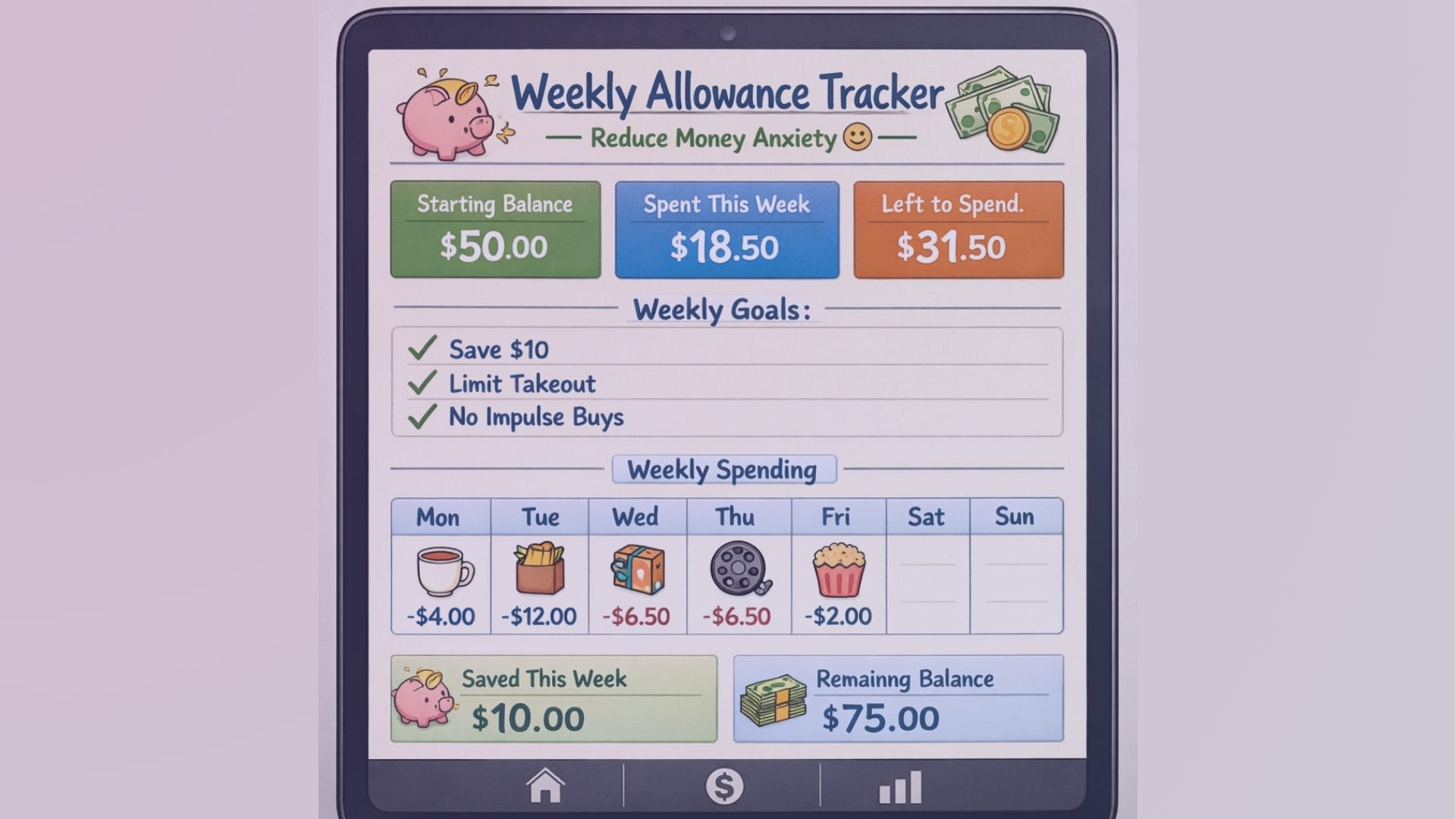
Whatever is left after fixed costs gets divided by 4.3, the average number of weeks in a month. That figure becomes your weekly allowance, loaded onto a separate card or digital wallet every Monday. You are now managing a week, not an entire month at once.
If Friday arrives and there is money left, it moves straight to your emergency fund. If Wednesday's spending ran over, you live a little tighter through Sunday, not through the end of the month. That boundary is what prevents the slow collapse into hopelessness that monthly budgeting so often triggers.
One of the most effective mindful spending practices for solo earners is the 24-hour rule: if something was not planned in this week's budget, add it to your cart but do not check out. Come back the next day. Research consistently shows the urge to buy drops by 70-80% within 24 hours, and the decision becomes far easier to make clearly.
Takeaway: A weekly allowance system is not restriction. It is decision freedom. When you know exactly what you have for the current week, every purchase becomes a simple choice rather than an open-ended source of background dread.
Why your mini emergency fund is a nervous system buffer, not a financial goal
One of the most repeated pieces of financial advice is to build an emergency fund covering six months of expenses. For solo earners, this advice often generates more anxiety than reassurance, because the target feels unreachable and the timeline feels punishing.
That is why the framing matters so much. A mini emergency fund's primary function is not financial but neurological. Its job is to make sure that one unexpected expense, a broken phone, an unplanned medical bill, a car repair, does not spiral into panic. It is the sum that tells your brain: "even if something goes wrong today, everything does not collapse."
| Level | Target amount (US) | What it covers | Effect on the nervous system |
|---|---|---|---|
| Level 1 (starter) | $250-$500 | Small unexpected cost | Stops complete collapse |
| Level 2 (buffer) | $500-$1,000 | Phone, appliance replacement | Tangible sense of safety |
| Level 3 (goal) | $1,000-$2,000 | One month of crisis management | Real breathing room |
Research from OneUnited on financial trauma consistently finds that automated saving outperforms willpower. Set a fixed weekly transfer, even $10 to $25, moving automatically into a separate savings account every Monday. The amount is secondary. Building the habit is the point.
The anxiety around money in 2026 is partly driven by this absence of any buffer at all. Not because funds are critically low, but because the brain runs worst-case simulations continuously when there is no safety net in sight. A mini emergency fund interrupts that loop before it exhausts you.
Takeaway: The size of the fund matters less than the feeling it creates. Knowing that something unexpected will not immediately destroy your stability is the real value of a nervous system buffer.
The cost of financial shame: why staying silent is so expensive

Financial wellness advocate Dasha Kennedy argues that financial shame is one of the most expensive emotions a person can carry. Someone who feels ashamed of their financial situation tends not to ask for help, avoids confronting the actual numbers, and often overspends to keep up the appearance that everything is fine. The Wondermind interview with Kennedy unpacks this pattern with rare honesty and practical clarity.
Financial shame hits solo earners with particular force. When two people face a problem together, at least the weight is shared. When you face it alone, shame and responsibility land on you at the same time, with no one to offer a different perspective. The comparison spiral often follows: "everyone else seems to have it figured out." In reality, the single tax, the extra cost of not splitting rent, utilities and groceries, is a documented economic phenomenon, not a personal shortcoming.
According to research by National Debt Relief, people who experience strong financial shame delay financial decisions by an average of 30-40% longer than those who do not. That delay compounds into late fees, missed saving windows and deepening anxiety. Letting go of financial shame is not just a wellness exercise. It is a financially measurable act.
3 sentences worth rewriting in your head: rewiring your internal money script
Cognitive behavioural therapy (CBT) and neuroplasticity research both support the same conclusion: changing your internal money script is not self-deception. It is the foundation on which any functional financial system has to be built. The reframes below do not promise that everything will work out. They restore the one thing shame takes away: the capacity to take a next step.
Takeaway: Financial shame is not evidence of personal failure. It is the predictable result of carrying too much alone for too long. Reframing does not deny the reality. It gives you your agency back.
Frequently asked questions about budgeting for singles
Write down your fixed monthly costs, calculate what is left, and divide by 4.3. That number is your weekly allowance. It does not need to be perfect. It just needs to exist, a reference point you can return to when the end-of-month feeling starts creeping in.
If you feel like it, share in the comments: what is your biggest financial stressor right now? Rent, groceries, or the unexpected costs that come out of nowhere?
Matone Counseling: The psychological barriers to money management and the scarcity stack · Wondermind: How financial shame holds you back (Dasha Kennedy) · Norbert Hires: Morgan Housel, The Psychology of Money, summary · Intuit 2026 Forecast: financial trends and mindful spending · OneUnited: Financial trauma signs, symptoms and tools to heal your money story · National Debt Relief: Shame, silence and debt, how financial guilt keeps you stuck · The Jed Foundation: How to deal with money anxiety by building financial wellness
Some of the visual materials in this article were created with the assistance of artificial intelligence. Sources: Gemini, ChatGPT, Canva.
This article is intended for informational and educational purposes only and does not constitute financial, investment, legal or therapeutic advice. The methods described are general life-management perspectives, not recommendations tailored to any individual financial situation. If you are experiencing an acute financial crisis, severe anxiety or a mental health concern, please reach out to a qualified financial advisor, psychologist or other licensed professional for personalised support.