SEO Strategy 2026: The 7 Essential Steps for Guaranteed Success
Old SEO tactics are obsolete. In 2026, the secret to growing organic traffic is combining a solid technical SEO audit, precise search intent analysis and E-E-A-T content guidelines. This guide shows you how to do it right.
In 2026, search has fundamentally changed. AI has taken control of the results page, and a growing share of organic traffic is now consumed by synthesized answers, with no click required. The good news is that the right SEO strategy 2026 makes you visible not only in organic listings but also inside AI responses, if you know what to do.
What changed in search by 2026, and why are old tactics no longer enough?
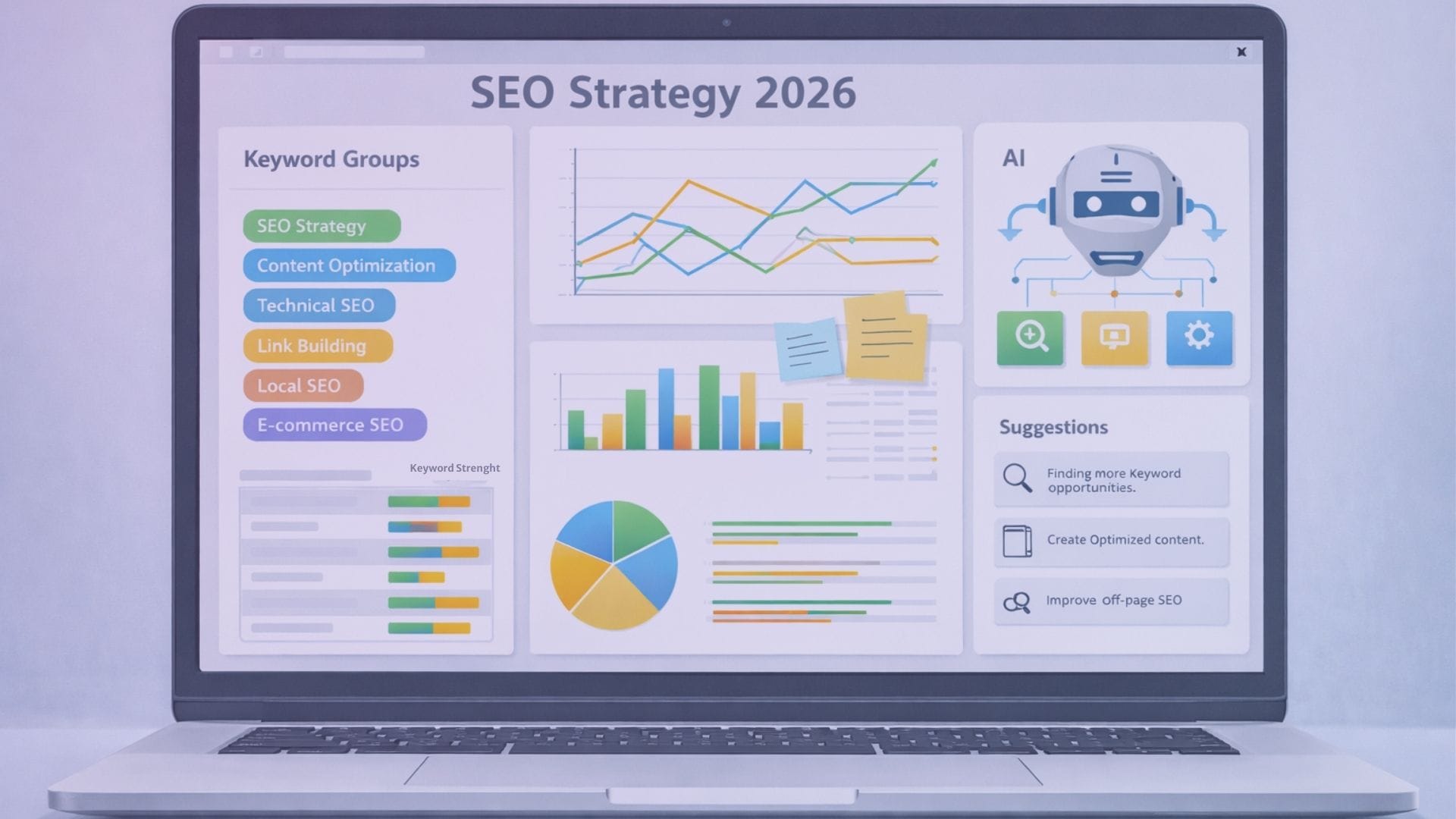
Three years ago, adequate keyword density and a handful of backlinks were enough in SEO. Today that is no longer sufficient. Google made two fundamental changes in 2025-2026. First, it introduced the AI Overviews panel, which delivers a synthesized answer above the search results. Second, the E-E-A-T (Experience, Expertise, Authoritativeness, Trustworthiness) criteria became mandatory weighting factors in the ranking algorithm.
The result is dramatic. According to SparkToro's 2025 research, 60-80% of Google searches now end as zero-click searches. This means the user receives their answer on the results page and never navigates further. At the same time, sites cited by AI receive a narrow but highly valuable stream of traffic: these visitors arrive with a much stronger conversion intent.
The collapse of old tactics has three main causes. First, semantic relevance has replaced keyword stuffing as the deciding factor. Second, low-quality backlinks have lost their value and now attract penalties. Third, neglecting a proper technical SEO audit, especially falling behind on Core Web Vitals, produces direct ranking losses.
Takeaway: In 2026, a successful SEO strategy rests on three pillars. Technical performance, credible content and an AI-compatible structure. If any one of these is missing, your competitiveness declines.
How to optimize Core Web Vitals for speed: a step-by-step technical SEO audit for 2026
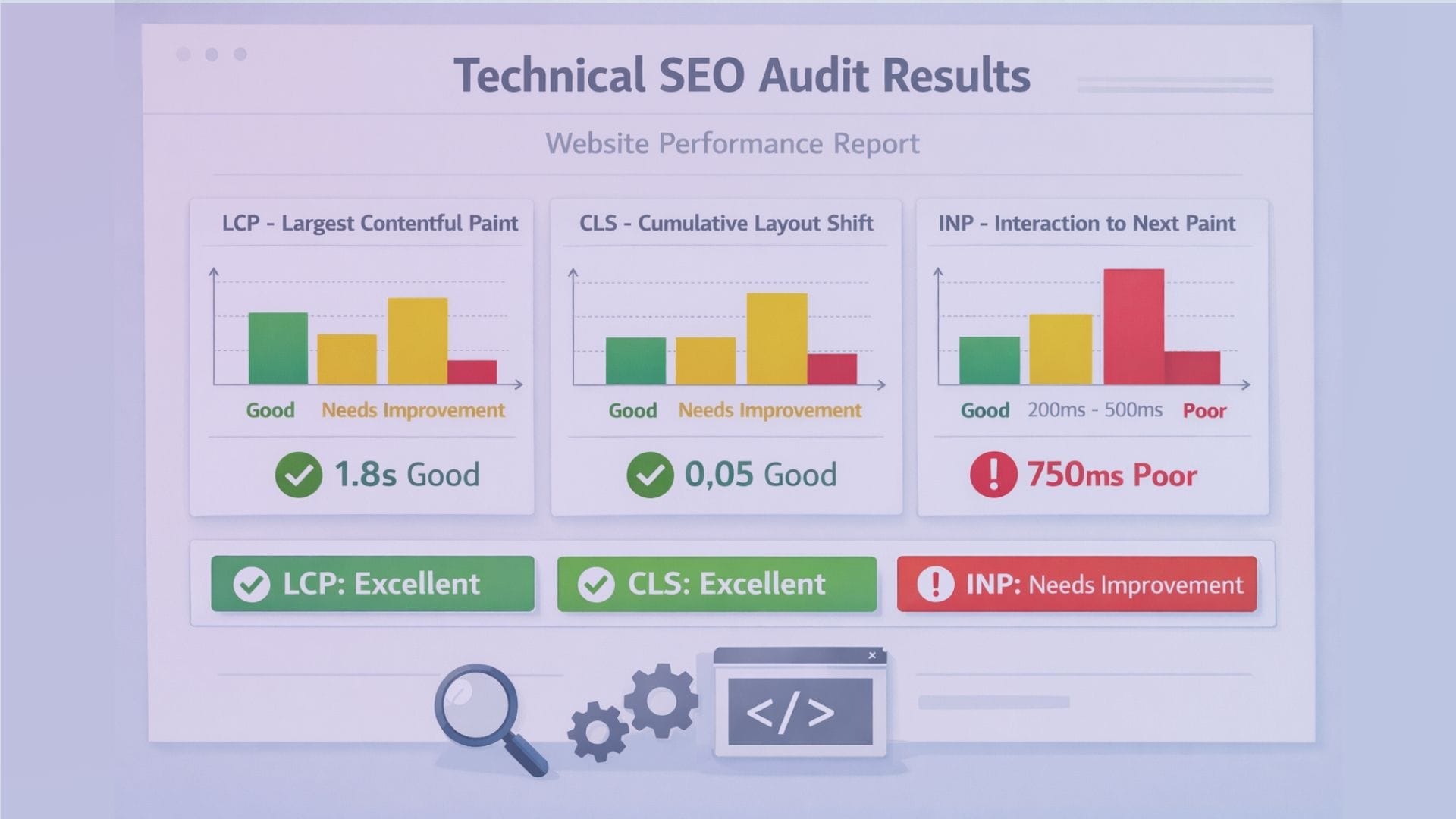
Core Web Vitals have been official ranking factors since 2021. In 2026, however, Google tightened the requirements: the INP (Interaction to Next Paint) metric has become the strictest threshold of all. Neglecting a regular technical SEO audit directly affects your chances of growing organic traffic.
The three most important Core Web Vitals metrics in 2026
| Metric | What it measures | Target value 2026 | Most common problem |
|---|---|---|---|
| LCP (Largest Contentful Paint) | Load time of the largest element | Under 2.5 seconds | Unoptimized images, slow server |
| CLS (Cumulative Layout Shift) | Visual stability, layout shifts | Under 0.1 | Images without declared dimensions, font swap |
| INP (Interaction to Next Paint) | Interaction response time | Under 200 ms | Heavy JavaScript, third-party scripts |
Improving Core Web Vitals is not a one-time task. It requires regular auditing, most efficiently with Google PageSpeed Insights or the tools provided by Google Search Central. A thorough technical SEO audit also includes adopting SSR (Server-Side Rendering) or SSG (Static Site Generation), particularly because AI crawlers often fail to process client-side-rendered JavaScript content correctly.
The fastest way to bring LCP below 2.5 seconds is image optimization. Switching to AVIF or WebP format reduces image file sizes by 30-50%, which directly improves load time and your chances of growing organic traffic.
Takeaway: Running a regular technical SEO audit, adopting SSR/SSG and improving Core Web Vitals metrics are the baseline conditions for organic visibility in 2026.
Search intent analysis: what does Google really want, and how do you read the signals?
Search intent analysis is no longer optional; it is a mandatory element of any serious SEO strategy 2026. Google does not simply match keywords; it tries to serve the underlying intent of the user. We distinguish four fundamental intent types.
The user is looking for information. Example: "What is GEO?" The right answer is a blog article, a guide or a definition box. AI Overviews readily cites this type of content when it is well-structured.
The user wants to reach a specific website. Example: "Google Search Console login." The answer here is a strong technical SEO foundation and clear brand identity presentation.
The user is comparing options and approaching a decision. Example: "best SEO tools 2026." The right content is a comparison table, a review or a detailed pro-and-con analysis.
The user wants to make a purchase. Example: "SEO audit service pricing." The correct solution is a landing page, a quote and a clear CTA, not a long blog article.
The most common mistake in search intent analysis is writing informational content for transactional keywords, or the reverse. Google detects this immediately and does not rank the content for the given query. According to Ahrefs' 2025 analysis, an intent mismatch can lead to losing 35-50% of organic traffic.
From a generative engine optimization perspective, question-form H2 headings increase the chance of AI citation by 40% compared to declarative headings (GEO-bench Research, 2025). Headings starting with "How?" and "What is the difference?" mirror real conversational search queries.
Takeaway: Before writing any article, identify the search intent. The type and format of content must always match the intent; otherwise Google will not rank it and AI will not cite it.
E-E-A-T content guidelines: how do you become a trusted source in the eyes of AI too?
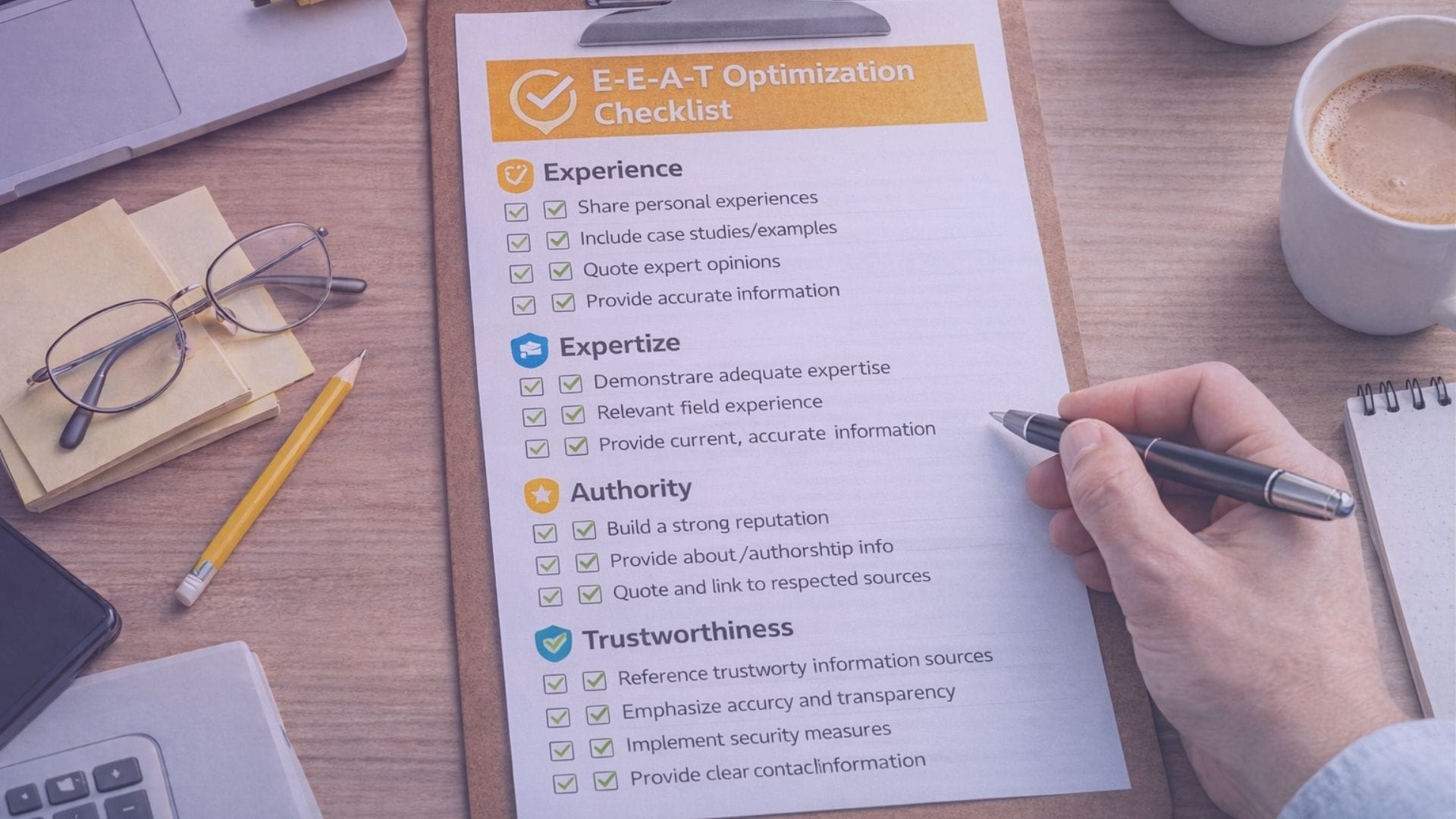
E-E-A-T (Experience, Expertise, Authoritativeness, Trustworthiness) has by 2026 become the most important source-qualification framework for AI systems, not just a Google guideline. 89% of LLM citations come from earned media, not from owned platforms (GEO-bench, 2025). This means the essence of applying E-E-A-T content guidelines is that other trusted platforms must write about you.
Practical implementation of the four E-E-A-T pillars
- Experience: Demonstrate real first-hand experience. Your own case studies, screenshots and concrete results send a far more credible signal than general claims.
- Expertise: Named author profiles, a verified LinkedIn page and a Wikidata entry are required. If an author's name appears nowhere in structured data, AI cannot distinguish them from an unknown actor.
- Authoritativeness: Digital press features, podcast appearances and professional conference citations. 76% of ChatGPT citations point to content published within the last 30 days (Ahrefs, 2025), so regular PR activity has a direct effect on AI citation rates.
- Trustworthiness: Peer-reviewed source citations for YMYL (Your Money or Your Life) content. HTTPS, a transparent privacy policy and clear author information are mandatory.
If your blog covers financial, health or legal topics, Google evaluates it in the YMYL category. At this category, applying E-E-A-T content guidelines is not just a ranking question: AdSense also reviews the content more strictly. Establishing a medical diagnosis, promising therapeutic outcomes or giving legal advice is prohibited.
Takeaway: Applying E-E-A-T content guidelines is not a one-time setup. It requires ongoing PR activity, a credible author profile and regular external references, without which AI will not include you among its trusted sources.
Differences between SEO, GEO and AEO: why is traditional SEO no longer enough?
Generative engine optimization, or GEO, appeared in academic literature in 2023 (Aggarwal et al., 2023, arXiv) and by 2026 had become one of the fastest-growing specializations in digital marketing. The underlying technology is called RAG (Retrieval-Augmented Generation).
GEO (Generative Engine Optimization) is the strategy that ensures your website's content is integrated into AI-generated synthesized responses, such as those in Google AI Overviews, ChatGPT or Perplexity. The key elements of GEO are modular, question-based content, Schema.org structured data and credible source references. Unlike traditional SEO, the goal is not a click but the appearance of your brand inside the AI response.
GEO and AEO (Answer Engine Optimization) are closely related but not identical. AEO focuses on featured snippets in traditional search engines. GEO targets the world of AI chatbots and synthesized responses. The core difference versus SEO: while SEO positions you in the SERP list, GEO names you inside the AI answer.
| Characteristic | Traditional SEO | GEO (Generative engine optimization) | AEO (Answer engine optimization) |
|---|---|---|---|
| Goal | SERP position, click | AI citation, brand mention | Featured snippet, instant answer |
| Content type | Keyword-rich text | Modular, structured blocks | Concise 40-60 word definitions |
| Primary signal | Backlink, PageRank | E-E-A-T, source triangulation | Schema.org, FAQ markup |
| Conversion rate | 2.1% (average) | ~27% (GEO-bench, 2025) | Medium, intent-dependent |
Takeaway: GEO does not replace SEO; it complements it. In 2026, the winning strategy optimizes simultaneously for the traditional search list and for AI responses. Neither alone is sufficient.
Building topical authority in your niche: how to win both search and AI in 2026?
Building topical authority in your niche is one of the most effective tools for rapidly growing organic traffic. Competition in niche-specific search results is considerably lower than on the global market. At the same time, AI and zero-click searches have reshaped niche visibility too.
Topical authority in 2026 is built on four main elements. The first is consistent content cluster coverage: every major question in your niche must have a dedicated, well-structured answer on your site. The second is precise use of semantic keyword variants, including conversational long-tail queries like "how to optimize Core Web Vitals for speed" or "differences between SEO, GEO and AEO." The third is the LocalBusiness or Article Schema.org markup, which AI systems process readily. The fourth is a niche-specific backlink profile: industry publications, association directories and expert roundups.
According to BrightLocal's 2025 research, 78% of websites that combine optimized Schema markup with active third-party mentions also appear in the AI Overviews panel for niche queries. Building topical authority therefore automatically generates a GEO advantage at the same time.
Takeaway: Building topical authority in your niche is the fastest path to sustainable organic visibility. A complete content cluster, semantic keyword coverage and consistent Schema markup make your site the go-to reference for both Google and AI systems in 2026.
Safely monetizing blog traffic with AdSense in 2026: what you need to know
Google AdSense rules tightened in 2026 in two major areas. The first is the Human-in-the-Loop requirement: content created with AI assistance must receive human editorial oversight. Purely machine-generated, unreviewed articles receive a Low Value Content flag, which leads to ad suspension. The second is the stricter E-E-A-T verification applied to YMYL content.
| Content category | AdSense compliance 2026 | Most important checkpoint |
|---|---|---|
| Health and mental wellbeing | Medical disclaimer required, outcome promises prohibited | Peer-reviewed source, E-E-A-T validation |
| Finance and investment | Cannot assume financial adviser liability | Clear disclaimer, source triangulation |
| Marketing and Tech | Factual accuracy, misleading AI promises prohibited | Source attribution, data dating |
| Pop culture and entertainment | Copyright compliance, AI plagiarism prohibited | Unique editorial viewpoint |
Safely monetizing blog traffic with AdSense at a high RPM (Revenue Per Mille, revenue per thousand impressions) in 2026 depends on three things: a strong E-E-A-T signal profile, the right advertising category and brand-safety compliance. Low-quality generated content not only earns less but can eventually result in removal from the AdSense program.
First mistake: AI content without human oversight. Second mistake: YMYL content without source references and a disclaimer. Third mistake: clickbait H1 and a misleading meta description. All three are sanctioned by both Google's algorithm and the AdSense review system.
Takeaway: AdSense rules in 2026 demand human editorial oversight and demonstrable E-E-A-T. Quality, credible content means both better organic rankings and higher advertising revenue at the same time.
Frequently asked questions about SEO strategy in 2026
Run a quick self-check: does your site meet the Core Web Vitals thresholds? Do you have structured Schema.org markup? Does your name appear in AI responses? If the answer to any of these questions is "no", it is time to start the 7-step strategy.
Test your website now →Google Search Central, 2026: technical SEO guidelines and Core Web Vitals documentation · Ahrefs Research, 2025: GEO measurement methodology and Citation Share · Aggarwal et al. (2023): Generative Engine Optimization, arXiv · SparkToro, 2025: zero-click search statistics · Google PageSpeed Insights: Core Web Vitals measurement tool · Google AdSense: content guidelines and YMYL rules 2026
The visual materials in this article were created with the assistance of artificial intelligence.