Why Did SEO Die? GEO Integration 2026: AI Will Either Cite You or Your Competitor
You hold the top spot in Google, yet traffic keeps dropping? Your competitor did not get better. AI made the decision for you, and if you have never heard of GEO, you arrived with this article at exactly the right moment.
SEO and GEO integration in 2026 is no longer an optional choice but the fundamental condition of digital existence. You hold the top spot in Google, yet traffic is falling? AI systems are citing your competitors but not you? This article shows you why, and what you can do about it.
GEO, or Generative Engine Optimization, is the strategy and process by which your website's content is integrated into synthesized responses generated by artificial intelligence. These responses can appear in the Google AI Overviews panel, in the answers of ChatGPT, Perplexity, Gemini or Claude chatbots, and even among Microsoft Copilot suggestions. The core idea: a user asks the AI a question, the AI responds, and you are the source it cites or names. If that is not you but your competitor, the next generation of users will learn their brand from AI instead of yours.
You optimize for traditional search engines. Google, Bing and the rest find your website and rank it in the ten blue links list. People click through and land on your page.
You optimize for AI engines. ChatGPT, Perplexity or Google AI Overviews generates a response, and in that response your name appears as the source. People may not click, but they learn your brand.
Where did GEO come from and why have you not heard about it until now?
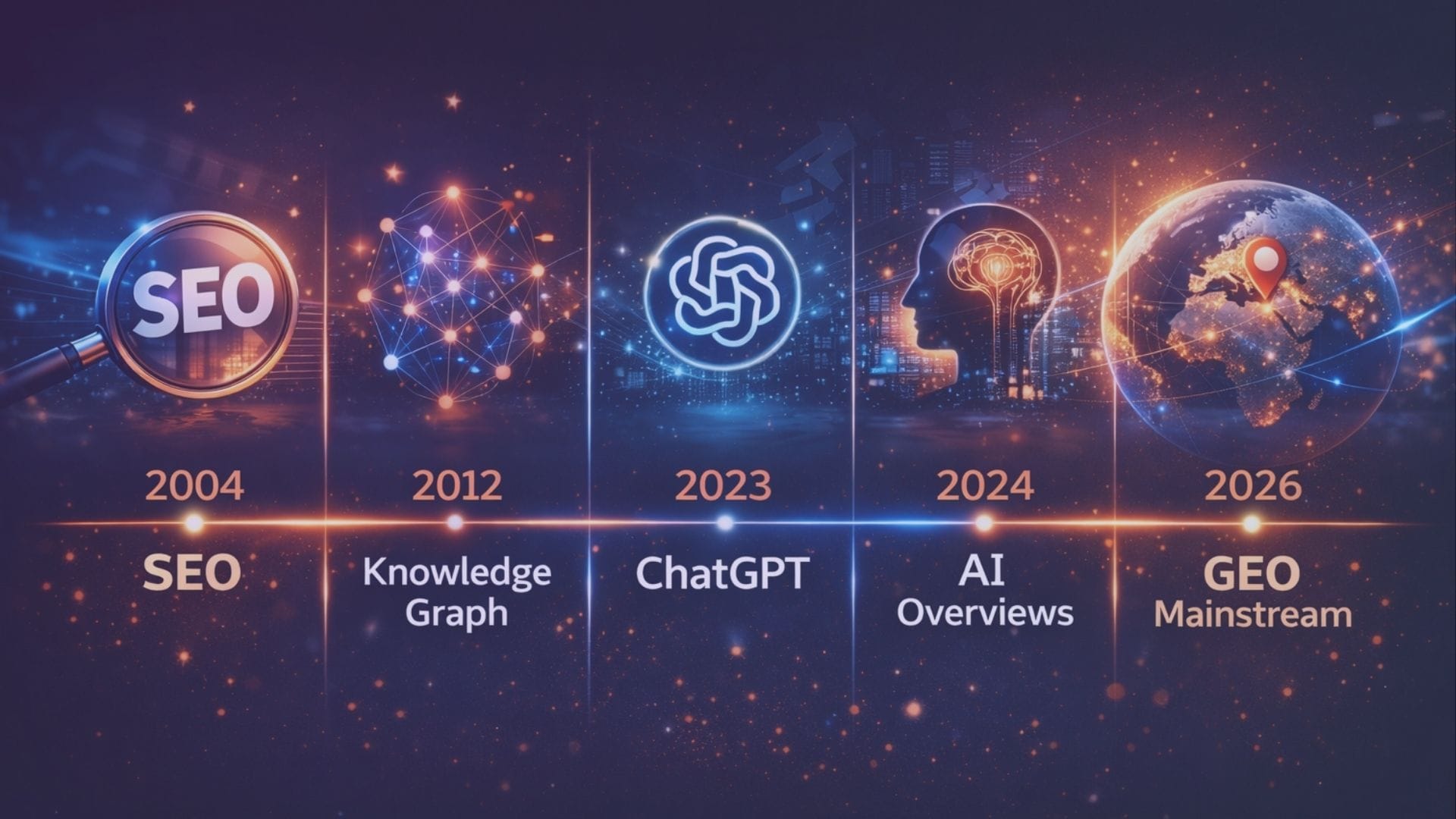
The concept of GEO appeared in academic literature in 2023 (Aggarwal et al., 2023, arXiv) and by 2025-2026 had become one of the fastest-growing specializations in digital marketing. The reason is simple: AI-based search engines operate on a fundamentally different architecture from traditional web crawlers.
Behind GEO lies an algorithmic architecture called RAG (Retrieval-Augmented Generation). This means the AI engine performs a real-time internet query before generating its response, extracts the sources it deems most trustworthy, then synthesizes them into a coherent answer. If your content is not "extractable", not modular and not structured, RAG skips you and says your competitor's name instead. If you start without SEO, AI will never find you. If you start without GEO, AI finds you but does not cite you.
The zero-click paradox: how do we win even when nobody clicks?
A zero-click search is a query where the user receives a satisfying answer directly on the results page or in the AI panel, without ever navigating to an external website. In 2026, 60-80% of Google searches end this way (Source: SparkToro, 2025).
At first glance this sounds catastrophic. If people do not click, why write content at all? The paradox is that the zero-click world has not brought the death of content but a new form of visibility. AI learns from somewhere too. ChatGPT, Perplexity and Google AI Overviews build their synthesized responses from someone's content, and that source is always named, either as a clickable link or as a verbal reference.
The 12-20% overlap figure is one of the most surprising numbers in 2026 research (Source: Ahrefs Research, 2025). It means that 80-88% of Google's top ten results are completely absent from AI responses, even though the AI system may process their content but cites a different, better-structured and more extractable source instead.
Many website owners believe that if organic traffic is stable, everything is fine. The reality is that brand mentions and AI citations can decouple from clickable traffic. A competitor can become the "trusted source" in AI's eyes today without your traffic or rankings visibly changing, but the next generation of users will learn the competitor's name from AI instead of yours.
Citation Share (AI citation share) is therefore the new brand-building metric. If someone asks on Perplexity "What is the best marketing blog in the UK?", and our name appears in the answer, that moment is worth more in the long run than ten organic clicks. The user did not click, but they learned about the brand and next time they will search for us directly.
How does semantic intent work in multilingual (HU, EN, RO) research?
LLMs (Large Language Models) do not search for words; they interpret meaning and context. Keyword research in 2026 is therefore no longer about analyzing monthly search volumes but about semantic intent mapping. Users no longer type "SEO tips" but "How do I transform my content strategy to stay visible in Perplexity's answers?"
| Category | Hungarian keyword example | English keyword example | Romanian keyword example | Intent type |
|---|---|---|---|---|
| Marketing and Tech | SEO vs GEO különbségek | SEO vs GEO differences 2026 | Diferența dintre SEO și GEO | Informational |
| AI search | AI-alapú keresőmotorok láthatóság | Generative search engines ranking | Motoare de căutare generative clasare | Comparative |
| Mental health | Szorongás kezelése digitális eszközökkel | Managing anxiety with AI tools | Gestionarea anxietății cu instrumente AI | Advisory |
| Pop culture | 2026 legjobb sci-fi filmjei | Best sci-fi movies 2026 | Cele mai bune filme sci-fi 2026 | Opinion-driven |
The critical advantage of multilingual SEO and GEO integration is that precisely defining local entities and cultural context creates a competitive edge where the English-language market is saturated. For a query like "managing anxiety in Hungary", AI systems have few options: there are very few structured, trustworthy Hungarian-language sources. The blog that fills this gap automatically gains a high Citation Share in AI responses for that market.
AI systems monitor how closely content resembles user prompts. Build in question-based H2 headings that mirror actual search queries. A "How?" and "What is the difference?" structure increases the chance of AI citation by 40% compared to flat, statement-based headings (Source: GEO-bench Research, 2025).
Competitive analysis: how do we measure AI Citation Share?
Measuring Citation Share is not yet automated in 2026, but the methodology can be developed. The basic principle: select 10-20 questions that your content answers best, then ask them verbatim in ChatGPT, Perplexity, Gemini and Claude. Document how many times your website appears as a source. That percentage is your Citation Share.
| AI Engine | Nature of cited sources | Optimization priority | Main competitor type |
|---|---|---|---|
| ChatGPT | LinkedIn, G2, Gartner, Wikipedia | Depth and conversational fluency | Professional platforms, white papers |
| Perplexity | YouTube, PeerSpot, academic sources | Real-time data, freshness | News portals, research reports |
| Gemini | Reddit, Medium, YouTube, Google Maps | Google ecosystem integration | Reddit threads, video content |
| Claude | Long-form guides, documentation | Expert tone, nuanced analysis | Technical documentation, guidebooks |
The table immediately shows that a multi-engine approach is necessary. What ChatGPT considers trustworthy (deep, data-rich analysis) is evaluated by Perplexity on the basis of freshness. Gemini thinks within Google's own ecosystem. Claude prefers nuanced content that presents multiple perspectives. No single content type can maximally serve all four, but with the right structure we can satisfy all four simultaneously.
The anatomy of the perfect 2026 article: modularity and the Machine-Human interface
The keyword of content planning in 2026 is modularity. Content can no longer be a linear narrative. It must be built from independently interpretable information blocks that AI can easily "extract" and incorporate into its response. Structured content increases the chance of AI citation by 40% compared to flowing prose (Source: Google Search Central, 2026).
| Structural element | Purpose | Technical implementation | GEO impact |
|---|---|---|---|
| Anchor text (AEO Snippet) | Immediate answer extraction | First <p> element, 40-50 words | Very high |
| TL;DR summary | Key data in one block | Separate div section, 100-150 words | High |
| Question-based H2 headings | Mirroring prompts | H2 starting with an interrogative sentence | High |
| FAQ section | People Also Ask and AI response | Schema.org FAQPage markup | Very high |
| Statistical tables | Data-based credibility | HTML table with source attribution | High |
| Vector-search-friendly segmentation | Supporting RAG algorithms | 800-token information blocks | Medium-High |
The role of the Snippet and TL;DR in AI extraction
The RAG (Retrieval-Augmented Generation) algorithms used by most modern AI search engines work by first retrieving relevant sources from a vector database, then synthesizing a response from those sources. The "extractability" of content is determined mainly by two elements: the first paragraph (AEO snippet, 40-50 words) and the FAQ section. Both must be concise, factual and interpretable as standalone sentences, free of marketing-copy style.
AI crawlers (and the Google bot alike) are slowed by JavaScript-based, client-side-rendered content. Server-Side Rendering (SSR) or Static Site Generation (SSG) are baseline requirements in 2026. Without them, an AI bot may time out during indexing and the content simply never enters the processing pipeline.
Source collection and E-E-A-T: credibility as AI's new currency
E-E-A-T (Experience, Expertise, Authoritativeness, Trustworthiness) has by 2026 become the most important source-qualification framework for AI systems. 89% of LLM citations come from "earned media", not from owned platforms (Source: GEO-bench, 2025). This means it is not enough to emphasize our expertise on our own blog: other trusted outlets must also write about us.
Citing PubMed, arXiv and industry white papers. For mental health topics this is especially critical: Google's YMYL (Your Money or Your Life) rules require mandatory source triangulation. AI only qualifies health content as a "safe source" if peer-reviewed references are also present.
A Wikidata entry and Crunchbase profile are not optional: AI knowledge graphs obtain "entity confirmation" from these databases. If a brand name or author name appears nowhere in structured data, AI cannot distinguish between us and an unknown actor.
Digital press appearances, podcast features and professional conference citations have become cornerstones of GEO in 2026. 76% of ChatGPT citations point to content published within the last 30 days (Source: Ahrefs Research, 2025), so regular PR activity has a direct effect on AI citation rates.
Reddit and LinkedIn function as "training data" for AI models. Active, credible presence on these platforms, where we genuinely add value to the community, directly influences brand associations in AI's knowledge graph.
For content about mental health (YMYL category), it is prohibited to establish a diagnosis, promise therapeutic outcomes or replace conventional medical treatment. Every such article must contain a medical disclaimer (e.g. "This article does not replace the opinion of a medical professional") and must cite peer-reviewed sources. These guidelines are strictly monitored by both Google AdSense and AI systems. (Source: PubMed protocols and Google Health Content Policy, 2026.)
AdSense and monetization: how do we stay profitable in AI's shadow?
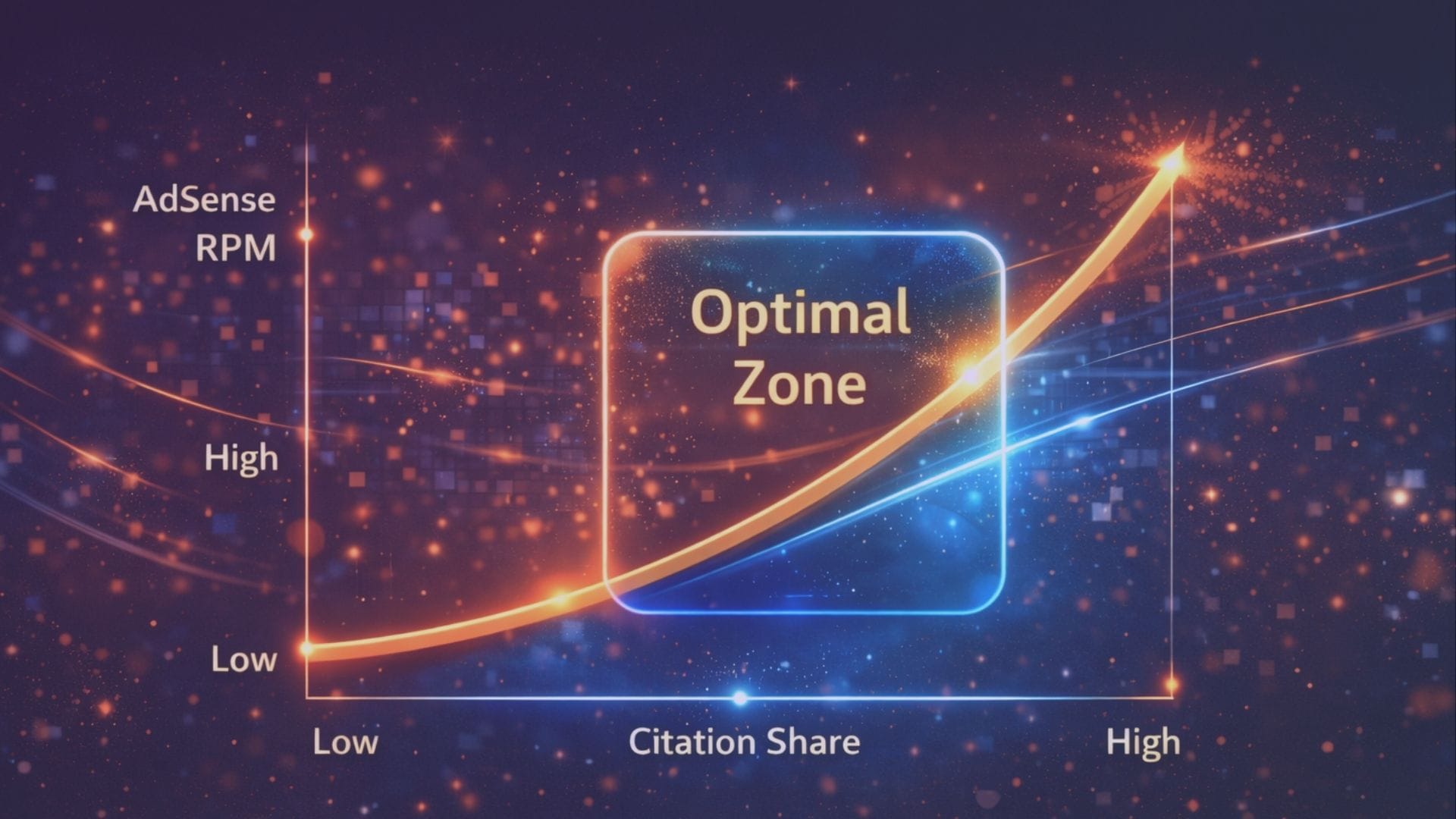
One of the most common questions in the zero-click world: if people do not click, how do we make money? The answer is nuanced. The direct click-based advertising model is genuinely under pressure, but SEO and GEO integration with a strong E-E-A-T signal profile produces higher-quality, lower-volume traffic that is far more valuable per visit.
| Content category | AdSense compliance 2026 | Most important checkpoint |
|---|---|---|
| Mental health | Medical disclaimer required, outcome promises prohibited | E-E-A-T validation, professional source |
| Marketing and Tech | Factual accuracy, misleading AI promises prohibited | Source attribution, data dating |
| Pop culture | Copyright compliance, AI plagiarism prohibited | Unique viewpoint, editorial critique |
| Current affairs and news | Transparent data handling (GDPR), fact-checking | Source triangulation, minimum 2 sources |
The 2026 AdSense "Human-in-the-Loop" requirement does not prohibit AI in content production, but it demands human editorial oversight. Purely machine-written, unreviewed articles can receive a Low Value Content flag, leading to ad suspension. The key to achieving a high RPM (Revenue Per Mille, revenue per thousand impressions) is high E-E-A-T, the right advertising category and content that meets the brand-safety standards of quality advertisers.
The 60-40 resource allocation model: where to keep your focus in 2026?
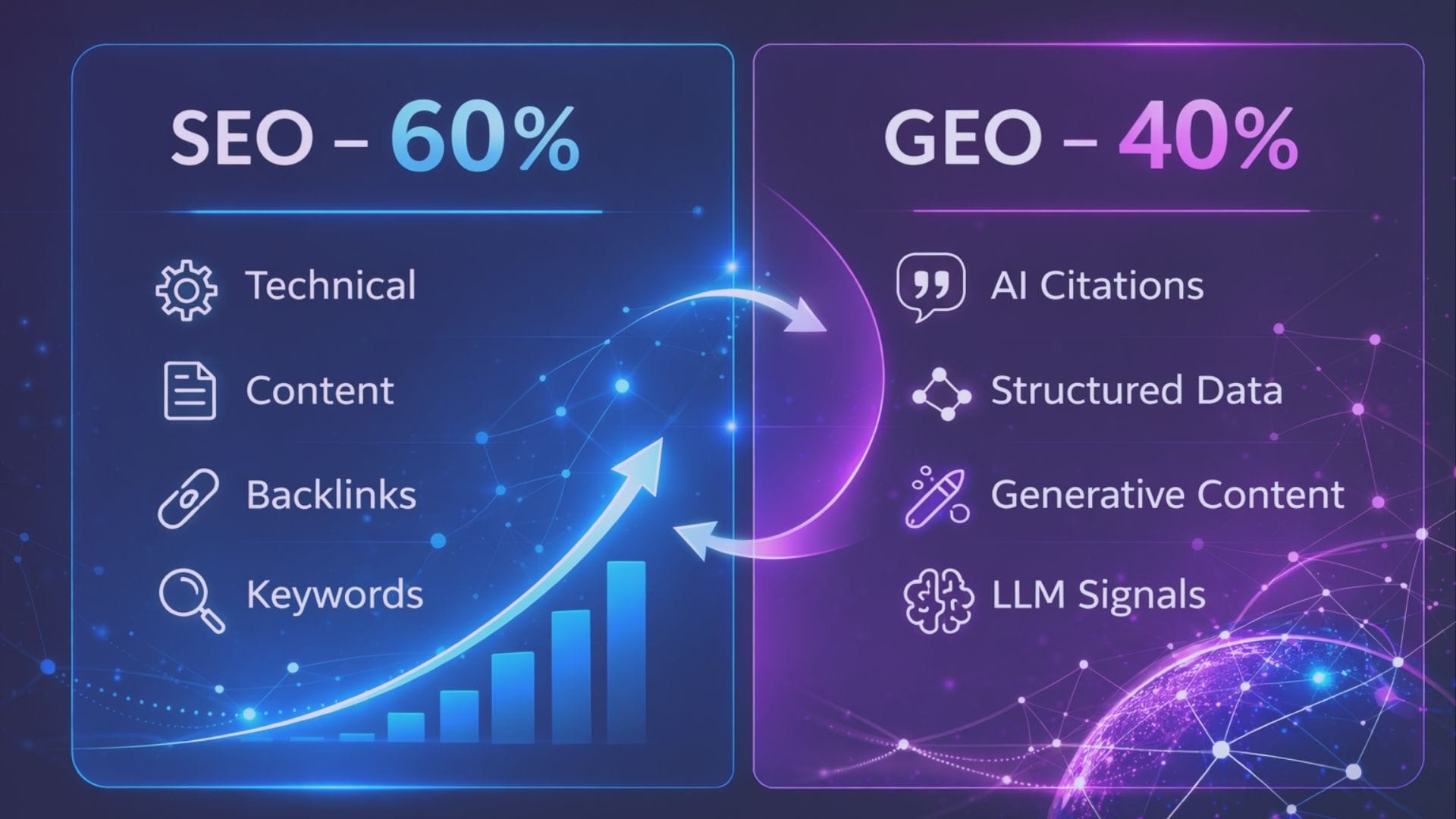
The SEO versus GEO debate is in reality a false dichotomy. The 2026 reality is symbiosis. If a website is not indexable, not fast and lacks foundational authority, AI will never find it. If a website ranks well but AI cannot extract its answers, the blog loses the synthetic search engines that account for 50-70% of traffic.
Core Web Vitals and mobile optimization. Keyword-based content production to retain traditional traffic. Building backlink profile and growing domain authority. Technical SEO audit and SSR/SSG groundwork. Monitoring traditional SERP positions.
Refining structured data (Schema.org). Producing FAQ blocks and AEO snippets. Entity reputation management and Wikidata profiles. Monthly AI Citation Share measurement. Building statistical databases and source triangulation.
Configuring server-side rendering, full Schema.org implementation (with particular attention to medical markups for the mental health category: MedicalWebPage, MedicalEntity), and optimizing robots.txt for AI crawlers. Running a baseline Citation Share measurement with 20 questions.
Authenticating author profiles and optimizing LinkedIn presence. Initiating Wikidata entries for the brand and authors. Establishing professional Reddit and LinkedIn presence where content is organically linked back.
Introducing RAG-based workflows: AI assists with drafting outlines and collecting data, but the final "voice" and ethical review are handled by a human editor. This is the only approach that satisfies the AdSense Human-in-the-Loop requirement.
Measuring "AI Visibility" monthly. Test: ask ChatGPT and Perplexity "What is the best marketing blog in the UK?" If the answer is not our blog, strengthening semantic clusters and source references is needed.
Frequently asked questions about SEO and GEO integration
Test your website on Perplexity right now. Type in a question that your page answers best. If your name does not appear, it is time to start a GEO strategy. The change does not begin tomorrow: the next generation of users is already learning brands from AI.
Test on Perplexity →Sources used and recommended
Google Search Central, 2026: technical SEO and content guidelines · Ahrefs Research, 2025: Citation Share and GEO measurement methodology · Aggarwal et al. (2023): GEO, Generative Engine Optimization, arXiv · SparkToro, 2025: zero-click search statistics · Google AdSense: content guidelines and YMYL rules 2026
Related Posts
The best SEO strategies in 2026 – 7 steps for succes
Home› Tech & SEO› SEO Strategy 2026 Tech & SEO SEO Strategy 2026: The 7...
Website image size – The complete system of website image optimization and sizing architecture in 2026
Website image size 2026: AVIF, WebP, Core Web Vitals, LCP optimization - complete guide.